Colorado agriculture is often associated with sweeping wheat fields, irrigated corn, mountain ranches and the produce of the San Luis Valley and Western Slope. But when agricultural production is measured by the market value of products sold, another picture emerges.
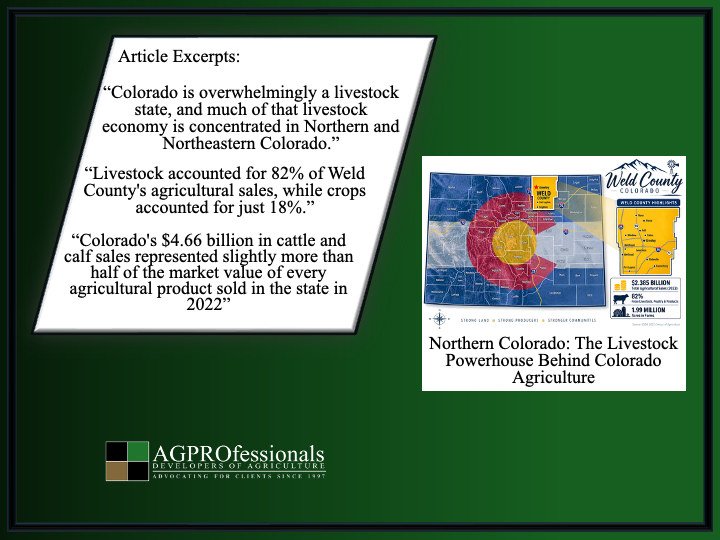
Colorado is overwhelmingly a livestock state, and much of that livestock economy is concentrated in Northern and Northeastern Colorado.
According to the USDA's 2022 Census of Agriculture, Colorado farms and ranches sold approximately $9.22 billion in agricultural products. Livestock, poultry and their products accounted for approximately $6.40 billion, or 69% of all Colorado agricultural sales, compared with approximately $2.82 billion from crops.
The information originally compiled for this analysis likewise identifies livestock as the dominant component of Colorado agricultural sales and points to Weld County and the Northern High Plains as the center of the state's cattle and dairy industries.
That concentration is particularly evident in Weld County.
Graphic 1: Colorado agriculture is livestock agriculture. Colorado agricultural sales, 2022 Livestock, poultry and livestock products generated 69% of Colorado's $9.22 billion in agricultural sales.
Weld County Is an Agricultural Economy of National Scale
In 2022, Weld County farmers and ranchers sold approximately $2.385 billion in agricultural products, representing about 26% of Colorado's entire agricultural market value from a single county.
Of that total:
- $1.945 billion came from livestock, poultry and livestock products.
- $982.4 million came from cattle and calves.
- $822.3 million came from milk from cows.
- $58.4 million came from sheep, goats, wool, mohair and milk.
- $72.2 million came from poultry and eggs.
Livestock accounted for 82% of Weld County's agricultural sales, while crops accounted for just 18%.
Those figures make Weld more than Colorado's leading agricultural county. USDA ranked Weld third among U.S. counties for total livestock, poultry and livestock-product sales, seventh for cattle and calf sales, sixth for milk sales, and first in the nation for sales of sheep, goats, wool, mohair and milk among counties whose rankings could be disclosed.
The scale is also visible in livestock inventories.
On December 31, 2022, Weld County reported 545,480 cattle and calves and 129,426 sheep and lambs.
This is production agriculture on a national scale.
Colorado's $6.4 Billion Livestock Economy
Statewide, cattle are the foundation of Colorado agricultural sales.
Colorado's $4.66 billion in cattle and calf sales represented slightly more than half of the market value of every agricultural product sold in the state in 2022. Milk contributed another $1.249 billion. Hogs and pigs generated approximately $210 million, poultry and eggs nearly $112 million, and sheep, goats, wool, mohair and milk nearly $98 million.
What drives Colorado agricultural sales?
Cattle and dairy alone represented approximately 64% of all Colorado agricultural sales in 2022.
All other agriculture
Cattle & calves
Milk from cows
Put another way, cattle and dairy alone generated approximately $5.91 billion, equivalent to roughly 64% of Colorado's total agricultural sales.
Those two categories alone represented about 64% of the value of every agricultural product sold in Colorado in 2022. Weld County's $1.945 billion livestock sector by itself was larger than Colorado's entire statewide grain, oilseed, dry bean and dry pea category, which totaled $1.548 billion.
That distinction matters when discussing Colorado agriculture.
Grain, hay and forage are important industries in their own right, but they also form part of the production system supporting the state's livestock sector. Corn can become cattle feed. Hay and silage support dairies and beef operations. Irrigated farmland can therefore contribute to livestock production long after a crop leaves the field.
The relationship between crop and livestock production is especially visible across the South Platte River corridor and Northeastern Plains.
The Northern Colorado Livestock Corridor
Weld County is the largest piece of the region's livestock economy, but it is not operating in isolation.
Moving east across Northern Colorado reveals a highly productive agricultural corridor encompassing Weld, Morgan, Logan and Yuma counties, with additional livestock production extending through Larimer, Phillips, Washington and Kit Carson counties.
Morgan County generated approximately $765.9 million in agricultural sales in 2022. An extraordinary 87% of those sales were livestock, poultry and livestock products, totaling approximately $670 million. The county had 245,516 cattle and calves in inventory at the end of 2022.
Logan County generated approximately $732.7 million in agricultural sales, with livestock and livestock products accounting for 84% of the county's sales.
Farther east, Yuma County generated approximately $1.091 billion in total agricultural sales. Livestock, poultry and livestock products accounted for approximately $803.1 million, including nearly $688 million in cattle and calf sales. Yuma County reported 255,184 cattle and calves at the end of 2022.
Larimer County presents a somewhat more diversified agricultural economy but remains livestock-oriented. Its farms generated approximately $270.6 million in agricultural sales, with livestock, poultry and livestock products accounting for 65% of sales.
Together, these counties illustrate that Colorado livestock production is not scattered randomly across the state. A substantial portion is concentrated along a broad Northern and Northeastern Colorado production belt.
Why Northern Colorado?
The geography is not accidental.
Northern Colorado combines several resources required for large-scale livestock agriculture: productive farmland, forage and feed production, irrigation infrastructure, transportation corridors, agricultural service businesses and a long-established base of livestock operations.
Weld County alone contained nearly 1.99 million acres of farmland in 2022. More than 1.04 million acres were classified as pastureland, while approximately 876,000 acres were cropland. The county also reported nearly 275,000 irrigated acres.
Feed production is closely integrated with the livestock economy. Weld County's leading crops by acreage included forage, corn for silage, wheat and corn for grain. Morgan County similarly reported substantial corn, forage and silage acreage, while Yuma County harvested more than 180,000 acres of corn for grain.
This creates an agricultural ecosystem rather than a collection of unrelated commodities.
Crops feed livestock. Livestock generate demand for grain and forage. Irrigation supports feed production. Livestock operations support veterinarians, nutritionists, truckers, equipment dealers, feed suppliers, engineers, agronomists, construction firms and other agricultural businesses.
The farm-gate numbers therefore represent only one layer of the economic activity associated with livestock production.
Dairy Is Particularly Concentrated in Weld County
Perhaps no statistic illustrates Northern Colorado's importance better than dairy.
Colorado farms sold approximately $1.249 billion in milk from cows in 2022. Weld County alone accounted for approximately $822.3 million of those sales.
That means roughly two-thirds of Colorado's milk sales originated in Weld County alone.
Weld was ranked sixth nationally among U.S. counties for milk sales in the 2022 Census of Agriculture.
Dairy production also helps explain the interconnected character of Northern Colorado agriculture. Dairy cattle require tremendous quantities of feed and forage, water, animal-health services, manure and nutrient management, transportation, labor and processing capacity. Consequently, the economic footprint of dairy extends far beyond the farm where cows are milked.
Beef Remains the Giant
Dairy's concentration is remarkable, but beef and cattle production remain Colorado agriculture's largest single economic component.
Cattle and calves generated approximately $4.66 billion statewide, accounting for 50.5% of the market value of all Colorado agricultural products sold in 2022.
Weld County alone generated approximately $982 million in cattle and calf sales. Yuma added approximately $688 million. Morgan reported approximately $414 million.
Those three counties alone therefore accounted for more than $2 billion in cattle and calf sales.
Colorado's beef industry encompasses several different production stages. Cow-calf operations utilize rangeland to produce calves. Backgrounding operations add weight before animals enter finishing systems. Feedlots concentrate cattle near feed supplies and transportation infrastructure. The Northern and Eastern Plains connect many of those pieces of the beef supply chain within a relatively compact geographic region.
Sheep and Lamb Production Adds Another National Distinction
Northern Colorado's livestock importance is not limited to cattle and dairy.
Weld County recorded approximately $58.4 million in sales in USDA's combined sheep, goats, wool, mohair and milk category, the highest reported county sales in the United States for that category in 2022. The county also reported 129,426 sheep and lambs in inventory.
Colorado as a whole generated approximately $97.9 million in this category and ranked second among states for sales.
Weld County therefore accounted for roughly 60% of Colorado's sales in the category, further demonstrating how strongly some of the state's major livestock sectors are concentrated in Northern Colorado.
Agriculture's Value Cannot Be Measured by Acres Alone
The Census data also highlight an important distinction in conversations about agricultural land.
The economic value of an agricultural acre is not determined solely by what is visibly growing on it.
A field of corn may be part of the beef supply chain. An alfalfa field may supply a dairy. Pasture supports breeding livestock. Silage acreage supports intensive dairy and cattle operations. Feedlots, dairies, processing facilities and agricultural service businesses depend on the surrounding land base.
That interdependence is especially important in Northern Colorado, where agricultural land increasingly exists alongside expanding communities, transportation infrastructure, residential development and competing demands for water.
When productive farmland is removed from agriculture, the impact can therefore extend beyond the value of the crop formerly produced on that particular parcel. It can also affect the larger livestock-production system that depends upon locally available feed, forage, land, water and supporting infrastructure.
A Region With Outsized Importance
The 2022 Census of Agriculture provides a remarkably clear picture.
Colorado sold $9.22 billion in agricultural products.
Nearly $6.4 billion came from livestock and livestock products.
Cattle and calves alone generated $4.66 billion.
And at the center of that production is Northern Colorado.
Weld County generated nearly $2.4 billion in agricultural sales by itself, with almost $1.95 billion coming from livestock. Morgan and Logan counties derived 87% and 84% of their agricultural sales, respectively, from livestock and livestock products, while Yuma generated more than $800 million from the sector.
These numbers demonstrate something that can easily be obscured as the Front Range grows.
Northern Colorado is not simply an area where livestock production still exists. It is one of the most economically significant livestock-producing regions in Colorado and, in several categories, in the United States.
The cattle in feedlots, cows in dairies, sheep and lambs, irrigated feed crops, pastureland and family farms scattered across the Northern Plains collectively form a multibillion-dollar production system.
Understanding the scale of that system is essential when Colorado considers questions involving agricultural land, water, infrastructure, development and the future of production agriculture.