
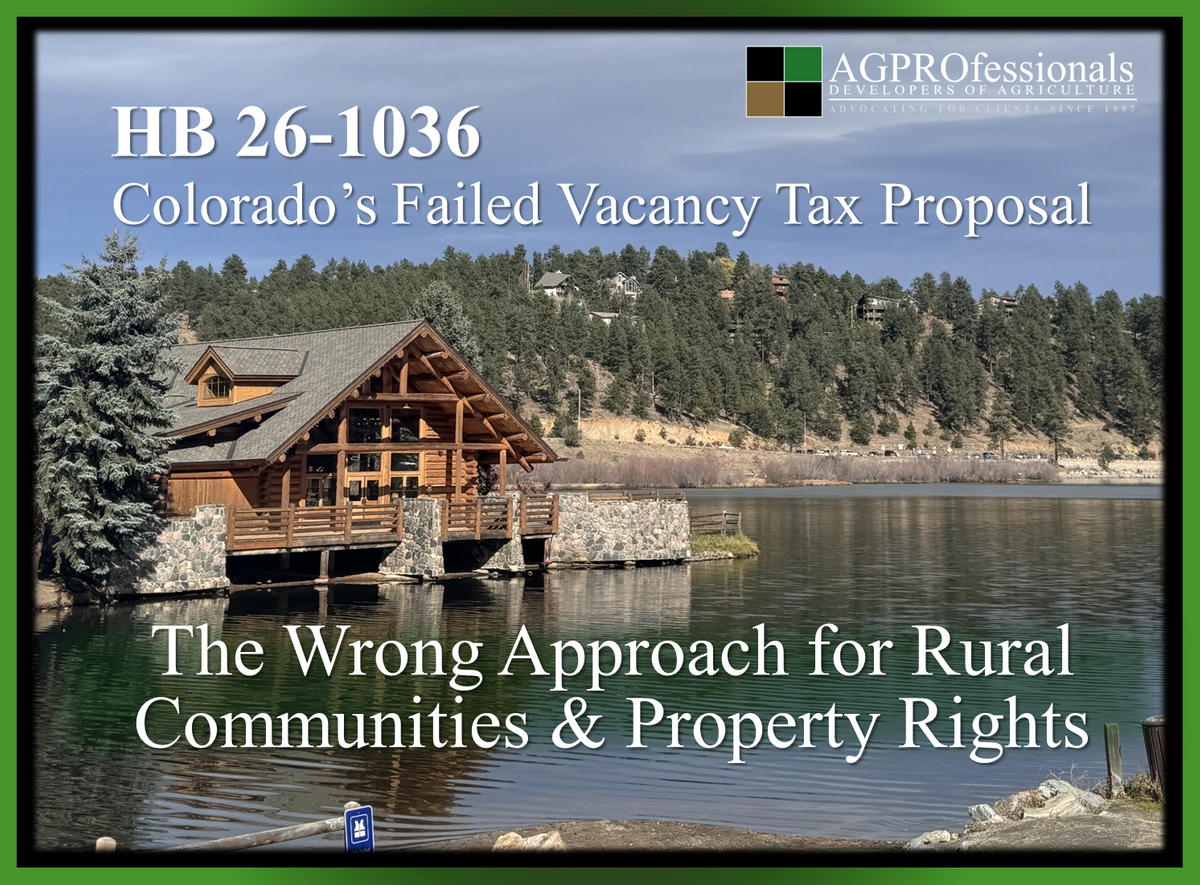
Colorado House Bill 26-1036 was introduced in January 2026 to authorize local governments to impose new taxes on “vacant residential properties.” The bill was aimed primarily at Colorado’s mountain and resort communities, where lawmakers argued that a high number of second homes contribute to local housing shortages.
Less than a month after its introduction, the measure was indefinitely postponed in the House Finance Committee after bipartisan opposition emerged from legislators, property owners, real estate professionals, homebuilders, agricultural interests, and rural advocates.
At AGPROfessionals Real Estate, we believe Colorado should address housing affordability and workforce housing shortages. However, HB 26-1036 represented the wrong solution. Instead of encouraging long-term economic growth and housing development, the proposal would have expanded government taxation authority while undermining private property rights, local investment, and rural economies.
What HB 26-1036 Would Have Done
The legislation would have allowed counties and municipalities to create and enforce:
- Excise taxes on vacant residential units;
- Additional property taxes on homes classified as “vacant residential property”; and
- Regional “housing tax authorities” capable of coordinating taxation across multiple jurisdictions.
The bill broadly defined vacant residential property as housing that is “unoccupied and not used as a residence for a specified amount of time,” while leaving local governments substantial discretion to determine what qualifies as “vacant.”
Supporters argued the measure would encourage second-home owners to rent out their properties and generate revenue for affordable housing programs in mountain communities facing severe workforce housing shortages.
Private Property Rights Matter
Colorado has a long tradition of respecting private property rights. Ownership includes the right to decide how property is used, occupied, maintained, or held for future family or business purposes, so long as that use complies with existing law. HB 26-1036 would have dramatically shifted that principle.
Under the proposal, local governments could effectively penalize owners merely because officials thought a home was not occupied often enough. Even more concerning, many of the individuals targeted by the legislation would have had little or no ability to vote on the taxes imposed against them because they are not full-time Colorado residents. The lack of representation raises serious fairness concerns. A property owner who lawfully purchased a home, pays property taxes, maintains the property, supports local contractors, and contributes to the local economy should not be punished because they are not physically present year-round. Ownership itself should not become a taxable offense.
Second-Home Owners Are Important Economic Contributors
In many mountain and resort communities, second-home owners play a major role in sustaining the local economy. These owners pay substantial property taxes, support local restaurants, retailers, and service providers, hire contractors, landscapers, property managers, and agricultural operators, donate to nonprofits and community organizations, and invest in communities for the long term.
As noted during committee hearings, second-home owners often contribute disproportionately to local tax bases while using fewer year-round public services than full-time residents. Policies that discourage investment in rural and resort communities can have ripple effects far beyond the housing market. Reduced investment can negatively affect construction jobs, agricultural suppliers, tourism economies, and small businesses that depend on seasonal residents and visitors.
Colorado’s rural economies are interconnected. Policies that create uncertainty for property ownership can weaken broader confidence in investing across the state.
HB 06-1036 Risked Expanding Bureaucracy Without Solving Supply Problems
One of the largest concerns surrounding HB 26-1036 was that it focused on taxation rather than housing production. The bill would have allowed the creation of new local housing tax authorities with independent powers to levy, collect, enforce, finance, and administer taxes across multiple jurisdictions. Taxes alone do not solve housing shortages. Critics of HB 26-1036, as quoted in legislative testimony, emphasized that increasing housing supply, not punishing property ownership, is the more effective long-term solution. This proposal did not even acknowledge the root causes of Colorado’s housing issues, which are:
- Restrictive land-use policies
- Lengthy permitting timelines
- Infrastructure limitations
- Construction costs
- Regulatory burdens
- Local opposition to higher-density development
If Colorado communities genuinely want more attainable housing, policymakers should prioritize reducing unnecessary barriers to construction, including streamlined permitting, infrastructure investment, sensible zoning reform, and incentives for workforce housing development.
Why Agricultural and Rural Stakeholders Were Right to Be Concerned
Organizations representing agriculture, real estate, property owners, and homebuilders justifiably opposed the measure. Rural landowners already face increasing regulatory pressure, rising operational costs, water uncertainty, and property tax challenges. Expanding local authority to classify and penalize property use introduces another layer of uncertainty into property ownership and investment decisions.
Predictability matters for agricultural producers and rural property owners. Long-term investment in land, infrastructure, agricultural improvements, and rural communities depends on confidence that ownership rights will remain stable and protected.
A Better Path Forward for Colorado Housing
Housing affordability is a serious challenge. Lasting solutions require increasing opportunities and supply, not creating new taxes on people who legally own and responsibly maintain property. Policies that normalize punitive taxation based on subjective occupancy standards move Colorado in the wrong direction.
Colorado can pursue housing solutions without undermining property rights, and the bipartisan defeat of HB 26-1036 suggests lawmakers recognized that concern. At AGPROfessionals, we will continue to advocate for balanced policies that protect rural communities, strengthen Colorado's economies, and defend the fundamental rights of private property owners.
Links