
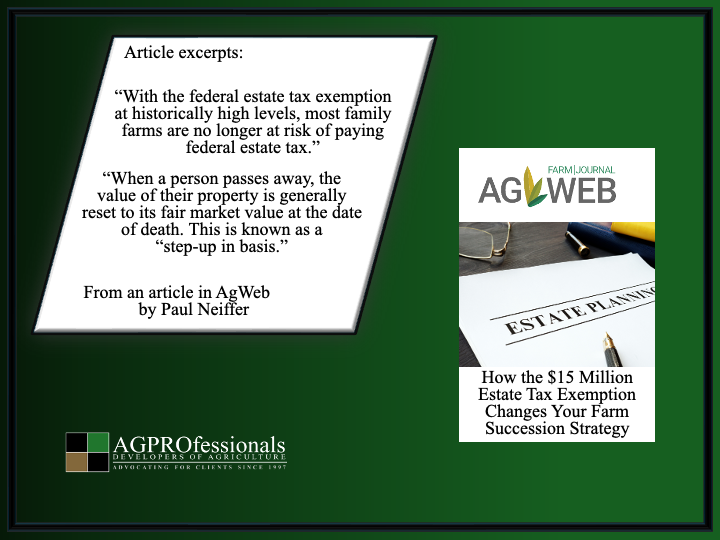
The world of estate planning for farmers has changed dramatically after the passage of the One Big Beautiful Bill Act. This permanently increased the lifetime gift and estate tax exemption to $15 million indexed starting Jan. 1. With the federal estate tax exemption at historically high levels, most family farms are no longer at risk of paying federal estate tax. However, this shift has brought a new focus to income tax planning and the importance of preserving the step-up in basis at death.
Understand the Step-Up in Basis
When a person passes away, the value of their property is generally reset to its fair market value at the date of death. This is known as a “step-up in basis.” For farm families, this is a crucial benefit. Farmland and other agricultural assets often appreciate significantly over time. If heirs inherit these assets, they receive them at the new, higher value. This means that if they later sell the property, they will owe little or no income tax on the appreciation that occurred during the original owner’s lifetime.
Why Estate Tax Is Less of a Concern
With the current high exemption, only the largest farm estates face federal estate tax. For most families, the bigger risk is not estate tax; it’s the potential for large income taxes if the step-up in basis is lost. This can happen if assets are given away during the owner’s lifetime, rather than being passed on at death.
The Pitfalls of Lifetime Gifting
Many farmers consider making large gifts during their lifetime, worried that the estate tax exemption will drop in the future. While this can be a good strategy for very large estates, it can be costly for smaller farm operations. When assets are gifted during life, the recipient takes over the original owner’s basis, which is often much lower than today’s value.
If the recipient later sells the property, they could face a significant income tax bill. In contrast, if the property is inherited, the basis is stepped up to current value, minimizing or eliminating income tax.
Likely the best asset to gift during lifetime is farmland that will be retained in the family for multiple generations. The step-up in this case is not as valuable because we can’t depreciate farmland, and if it is not going to be sold, the heirs are not worse off. Plus, appreciation in farmland can be very volatile and could cause the farm couple to owe estate tax.
Hidden Cost of Gifting Negative Capital
Many farm operations are structured as a partnership for income tax purposes and farms with debt will typically create what is called a negative capital account and, in many cases, this can easily exceed $5 to $10 million for larger farm operations. Gifting any interest in these partnerships during a lifetime will create ordinary income to the farmer because the “debt” eliminated exceeds the basis in the partnership’s assets, which is typically zero. Whereas holding until death eliminates the tax for their heirs. However, a drawback is that the older generation might still be on the hook for the debt until they pass.
For the vast majority of farmers, estate tax planning is now about smart income tax planning. Preserving the step-up in basis at death can save heirs substantial taxes and help keep the family farm in the family. Careful planning today can help protect your family’s legacy for generations to come.