
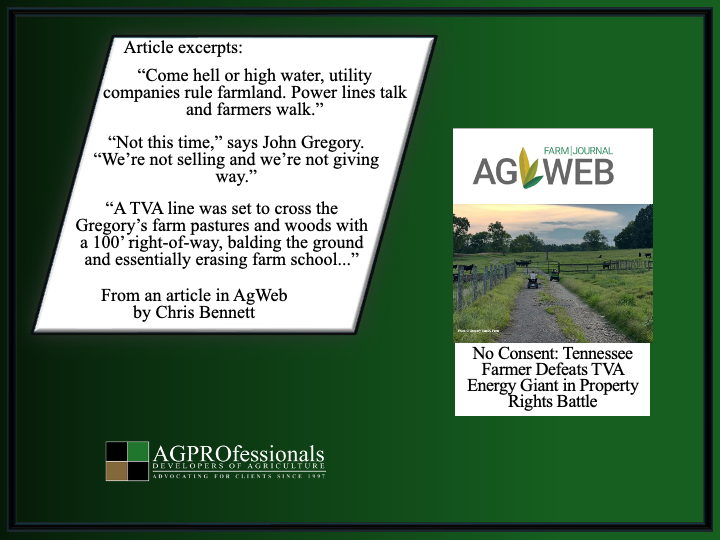
Come hell or high water, utility companies rule farmland. Power lines talk and farmers walk.
“Not this time,” says John Gregory. “We’re not selling and we’re not giving way.”
The Tennessee Valley Authority (TVA) intended to carve a pole-and-wire corridor through Gregory’s 650 acres—a 239-year-old historic family farm founded at the close of the American Revolution.
“They thought they could run over us, but this is the age of digital and social media,” he says. “They didn’t expect for the public to find out what they were doing and they didn’t expect farmers to have a voice.”
Cheapest and Fastest
Thirty miles northeast of Nashville, John and Kaytlin Gregory, alongside John’s father, Robert “Frosty” Gregory, background steers, and grow corn and soybeans, outside Gallatin, in Sumner County, Tennessee. In addition to direct-to-consumer beef, pork, and chicken, Kaytlin runs a booming farm school and homeschool program, bringing in elementary kids from the Nashville metro to learn the basics of row crops, livestock, pollination, wildlife, weather, and nature. She barely keeps up with demand: First started in 2023 with 30 kids, the hands-on sessions now draw 300-plus participants.
“Families who preserve their property are the ones who get penalized because eventually the utility companies or the government can take advantage of what you saved,” says John Gregory.
(Photo by Gregory Family Farm)
“For some of these kids, it’s the only exposure they get to agriculture and the outdoors during their entire childhoods,” Kaytlin explains.
“That’s what has always been done on this farm,” John adds. “Find a way to meet a need and provide for our community. We’ve done it for almost 240 years.”
Sincerely. In 1787, Revolutionary War veteran Joseph Wallace, of Mecklenburg, North Carolina, earned 640 acres for his militia service. Family in tow, he crossed the Blue Ridge Mountains and settled in Sumner County. Nine generations of full-time farmers later, his direct descendants still work the land.
“That’s who we are,” John says. “But our survival was put under threat from a power line.”
A TVA line was set to cross the Gregory’s farm pastures and woods with a 100’ right-of-way, balding the ground and essentially erasing farm school.
“It would destroy what we do and what we’ve worked so hard to build,” Kaytlin says. “TVA proposed 10 posts with guidelines across the farm. All vegetation and trees removed in the corridor, and that means they’d take out the exact trail and creek crossing and education area we use for farm school.”
“It was all so unnecessary,” John says. “This is not about the inconvenience of farming around a light pole. This is about tearing up the entire way our farm works. They can easily go another way, and everyone knows it. This is not the way to treat people.”
“Families who preserve their property are the ones who get penalized because eventually the utility companies or the government can take advantage of what you saved,” he adds. “They see a wide-open parcel on a map and roll in because it’s the cheapest and fastest route.”
Significantly, TVA promotes itself as a model of “environmental stewardship,” a claim John dismisses. “TVA wanted to plow through our 239-year-old farm to run power to a mega-development with over 1,000 houses stacked on top of each other and destroy the land we use to teach kids about the outdoors, animals, and agriculture. That is TVA’s idea of environmentalism?”
Making Noise
The proposed power line first poked the Gregory property in spring of 2024 via a snail-mail letter from TVA. Paraphrased: A power line is coming via multiple potential routes, and your land may or may not be in one of those routes.
“They had a public forum in May to come by and voice your opinion,” John notes. “They also had it open online to make comments. That was it. After the forum, everything went silent. I didn’t think any more about it.”
Three months later, on August 25, a TVA surveyor pulled up to the Gregory farm shop, according to John, and stated, “I’m here to survey where the power lines are coming across and I need permission.”
The surveyor showed John where the lines would run across the farm: “I could see right away it would ruin everything me and Kaitlyn had worked on, plus the rest of the farm. Seemed like this just couldn’t be happening.”
The chain of process was in motion. Survey. Historical study. Ecological study. In mid-January 2025, TVA workers placed stubs precisely where permanent poles would be stationed.
“By this point, there was yet to be a TVA representative set foot on the farm or even a letter in the mail talking about buying the easement or purchasing the easement,” John recounts. “Every time they came to do something, my dad asked to speak to somebody in charge and he’d get the same answer, ‘That’s further up the token pole. I’m just here to do a job.’”
Frosty’s patience was gone. He demanded a TVA official high in the brass. “Finally, a TVA engineer called my dad, and he told the guy about our farm school and what a power line would do to our farm school.”
The engineer, according to John, insinuated that farm school was a “made-up” cover, and insisted on proof of its existence.
Kaytlin responded with online links, signup information, and social media videos as proof of the farm school’s wide outreach and success. “TVA knew the power line would put an end to our agriculture education programs,” she contends. “They knew farm school was a crucial part of our farm. They knew our farm was in continuous operation since the Revolutionary War. They just didn’t care.”
“My dad reached out to the TVA guys again and again,” John explains. “That’s when they shut the door and said, “No. There’s nothing we can do.”
John, Katylin, and Frosty were supposed to roll. “No way,” John adds. “That’s when we started to make noise.”
All Hands on Deck
Initially, the Gregorys put crosshairs on a single goal: Get one particularly imposing pole removed and pray that farm school could still function.
“Didn’t work,” John says. “They wouldn’t talk to us about it. Not even a single pole off the table.”
All hands on deck. John and Kaytlin began making calls, pleading for help: TVA reps, engineers, state legislators, congressmen, media. Anyone. Everyone.
They cranked out a petition and spoke out in social media videos, hoping to gain attention.
And then some. They caught the eyes and ears of a heavyweight country music star and songwriter. Enter an irate John Rich, a major league advocate of property rights, who ran their story up the viral flagpole: The Gregory Family does NOT CONSENT to the @TVAnews running transmission lines across their 239 year old, Revolutionary War Era farm. Thank you @jeremymansfield for ringing the bell! I call on @SecRollins and @USDA to look into this ASAP.
(In 2025, Rich led successful grassroots opposition to a proposed TVA power plant in Cheatham County, Tennessee. In February 2026, he was appointed as a citizen advocate by USDA to help roll out the Farmer and Rancher Freedom Framework, aimed at countering ag lawfare.)
“Well, wouldn’t you know?” John recalls. “Almost instantly, TVA called telling my dad that they’d move that single pole anywhere on the farm so they could come across.”
Frosty responded with a line in the sand: I’m not agreeing to that. No consent. We don’t want this power line.
The Gregorys had found their voice.
Blood, Sweat, and Tears
“Publicly, TVA pretended our opposition was the first they’d heard about any of this,” Kaytlin explains.
Significantly, TVA released statements claiming ignorance regarding Gregory family resistance to the power line: “TVA has been working directly with Mr. Robert Gregory, the landowner, for several months and this concern had not previously been raised.”
“Not true,” Kaytlin counters. “We’ve got texts to prove otherwise. Frosty was against the line from the start, but they wouldn’t listen or let him talk to anyone up high. They never came around to have conversations with surrounding landowners. It’s very clear: TVA assumed we would all do exactly as we were told. It works for them everywhere else, but not this time. This was never about anything except protecting our farm.”
Money played no role, she explains. As in, there was no holdout or hope for a big payout. “Money. Money. Money. That’s comical,” she exclaims. “We’ve broken our backs with blood, sweat, and tears to keep this farm going. That’s what we care about and that’s why its lasted for 240 years. We’re not selling, period.”
“My dad’s been approached close to 10 times in the last 15 years to sell this whole place,” John echoes. “The plans went from industrial stations to housing developments. Every time, the people making those offers left with hat in hand. We’ve been here too long to sell. Some people see the dollars and don’t understand what I’m saying. Those people never will understand.”
In March 2026, with public discontent at full-bore, TVA ended the power line cut across Gregory Family Farm, choosing a different route.
A TVA spokesman told Agweb.com: “There was significant objection to a TVA-proposed route impacting the more than 200-year-old farm owned by the Gregory family. TVA has agreed not to pursue that route … TVA is exploring other options for the transmission line route, which would more closely follow existing rights of way.”
Additionally, TVA contends a newly-formed “Landowner Task Force,” including several farmers, will offer future input on energy projects.