
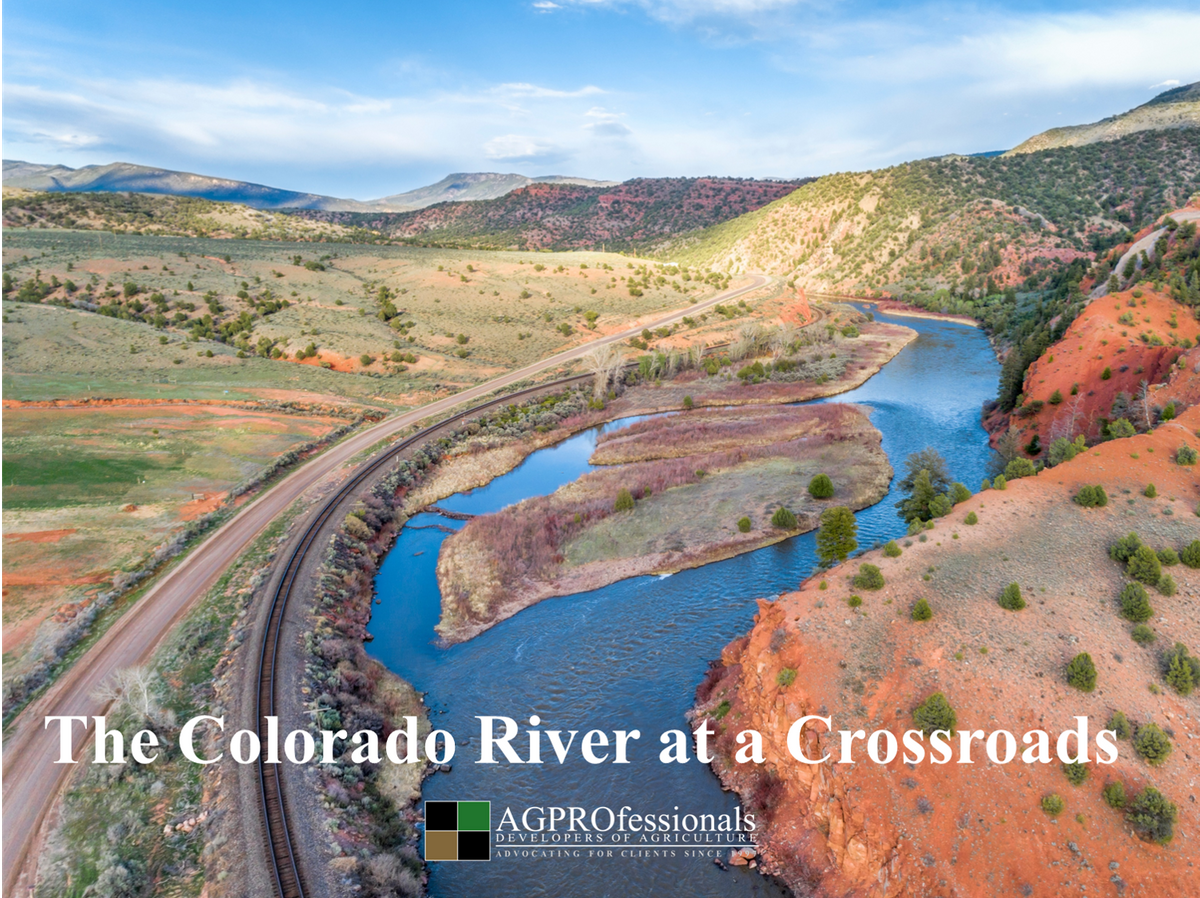
The Colorado River at a Crossroads
The Colorado River is more than just a water source. It is the economic backbone of Western agriculture and a key factor in the value of agricultural land across seven states. It irrigates about 5.5 million acres of farmland and supports rural economies from Wyoming to Southern California. Current federal management guidelines are set to expire in 2026. Therefore, decisions being discussed now will directly impact land values, water reliability, operational stability, and long-term agricultural investments throughout the basin. Understanding what is happening is crucial for landowners and agricultural investors.
The Colorado River Compact
The modern management of the Colorado River starts with the 1922 Colorado River Compact. The Compact assumed the river would produce about 16.5 million acre-feet (MAF) every year. Each basin was given 7.5 MAF, with the Lower Basin allowed to use an extra 1 MAF. But we now know that 1922 was an unusually wet year. The river’s long-term average flow is closer to 12.4 MAF per year.
The Colorado River Compact divides the river between:
Upper Basin States
- Colorado
- New Mexico
- Utah
- Wyoming
Lower Basin States
- Arizona
- California
- Nevada
In practical terms, more water was legally allocated than the river can reliably provide. That structural over-allocation is the root cause of today’s conflict. The current framework was built on hydrology that no longer exists. Extended drought, population growth, and municipal expansion have revealed the gap between paper allocations and actual water supply. For agricultural real estate, this matters greatly: water reliability underpins land value.
Why 2026 Is a Pivotal Year
Since 2007, the river has been governed by Interim Guidelines mainly linked to Lake Mead levels. In 2019, the basin states adopted a Drought Contingency Plan (DCP) to implement extra conservation measures. In 2023, Lower Basin states agreed to conserve 3 MAF before 2026, with the federal government covering 2.3 MAF. However, these guidelines will expire in 2026. The seven basin states have not reached an agreement on a unified plan beyond 2026. Instead, they presented competing proposals to the Bureau of Reclamation in 2024. The main disagreement centers on which basin should shoulder the burden of the shortage.
Lower Basin Proposal
- Shortages triggered by total basin storage
- Shared conservation obligations between Upper and Lower Basins
- Average reductions of approximately 1.5 MAF under most conditions
Upper Basin Proposal
- Shortages tied to combined levels of Lake Mead and Lake Powell
- Reduced releases from Lake Powell during low storage years
- Potentially less downstream water than historical expectations
Federal Authority
If states cannot agree, the Bureau of Reclamation has made it clear that it will act. A formal review under the National Environmental Policy Act (NEPA) is underway, and Reclamation has outlined five potential management pathways:
- No Action — Revert to pre-2007 rules
- Federal Authorities — Shortages imposed solely under federal statutory authority
- Federal Authorities Hybrid — Basin-wide proportional shortages
- Cooperative Conservation — Incentivized conservation and stewardship
- Basin Hybrid — Combination of state proposals
The important takeaway for landowners: federal leverage is increasing. Control over major infrastructure, the Hoover Dam and the Glen Canyon Dam, gives the federal government significant influence if negotiations fail.
Implications for Agricultural Producers and Landowners
Agriculture accounts for about 52% of Colorado River water use. This fact makes producers central to every conservation discussion. Meanwhile, municipal demand keeps rising in Phoenix, Las Vegas, and Los Angeles. The combination of urban growth and extended drought has caused Lake Mead and Lake Powell to reach historically low levels. From a property rights and real estate standpoint, several realities become clear.
1. Reductions Are Likely
Nearly all proposals contemplate basin-wide conservation triggers. Agriculture will almost certainly shoulder a significant share.
2. Compensation Is Political, Not Permanent
Recent agreements cover federal payments for voluntary conservation. However, long-term funding relies on Congressional appropriations. Landowners should not expect permanent compensation arrangements.
3. Senior Water Rights Still Matter
Under the “Law of the River,” water law in the West mainly follows the doctrine of prior appropriation: first in time, first in right. Senior agricultural water rights remain among the most valuable and protected assets in the basin. However, interstate compacts and federal authority add layers of complexity that can influence how shortages are shared. For buyers and sellers of agricultural land, priority date, diversion history, and adjudicated status are no longer just secondary details; they are now key factors in valuation.
4. Water Security Drives Land Value
Water uncertainty raises investment risk. Reliable, senior rights strengthen long-term stability and property value. In today’s environment, irrigated acreage cannot be assessed without a clear understanding of:
- Priority date
- Historical consumptive use
- Storage access
- Interstate compact exposure
- Federal infrastructure dependence
Where Agriculture Must Lead
The Colorado River feeds the nation. The 2026 framework will shape:
- The economic viability of irrigated agriculture
- The strength of rural communities
- The stability of agricultural land markets
- The enforceability of private property rights
Water policy is directly tied to real estate value. Agricultural stakeholders must remain actively engaged in the process and advocate for:
- Recognition and protection of senior water rights
- Preservation of food production as a national priority
- Voluntary, compensated conservation mechanisms
- Equitable burden-sharing between municipal and agricultural users
The Bottom Line for Agricultural Real Estate
As 2026 approaches, the reliability, structure, and enforceability of water rights will play a crucial role in land values across the West. At AGPROfessionals Real Estate, we recognize that agricultural property is more than just acreage; it’s a combination of land, water, rights, and long-term viability. In today’s climate, informed strategy and thorough due diligence are more important than ever.